
Holiday Gift Ideas
Give the gift of the Great Plains
Holiday shopping can be overwhelming, and we are here to make it easier for you. Explore our bestselling fine art prints, books, journals, and more!
BLACK FRIDAY SALE
Enjoy 15% off Fine Art Prints using code MFP1126 at checkout
The sale runs from November 25 to December 1
Bestselling Books
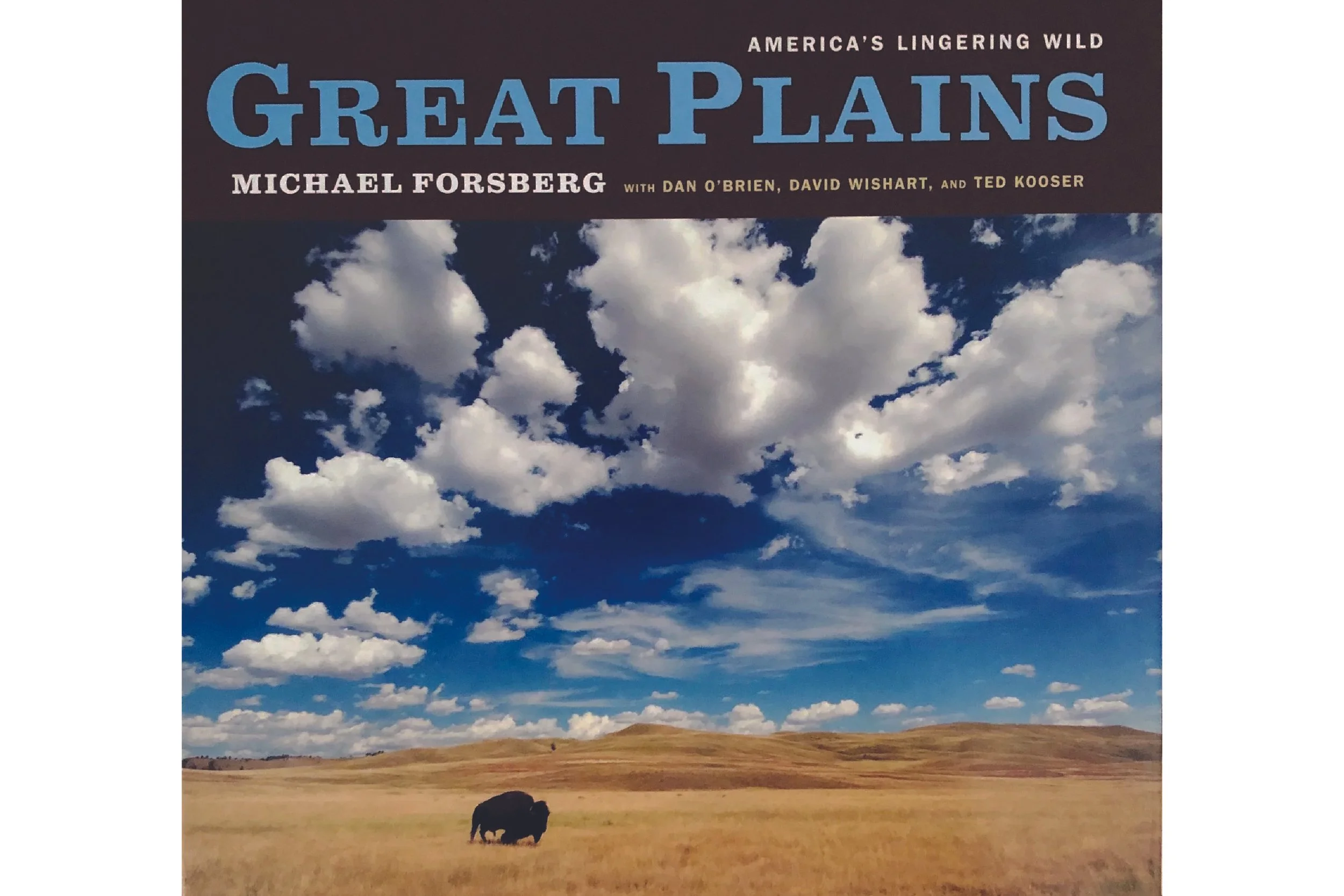
Two hundred years ago, before the gun, the plow, the pump, and the fence created one of the most altered environments on Earth, the world’s greatest natural grasslands teemed with life. But in the blink of an eye, modernization forever altered the American prairie. Scores of species vanished or were marginalized, and in the span of a century small towns bloomed, then withered, as economic and climatic forces shifted. Today, the great expanse of the Great Plains — measuring some 500 to 700 miles wide and 1,800 miles long — is a blank slate in the American consciousness. The big empty, fly-over country, the outback.
The immense distances, infinite horizons, enveloping skies, and harsh climate of the Plains have always conveyed to newcomers a sense of strangeness and unpredictability. Some 18,000 years ago, when humans first ventured onto the Plains, they chose not to stay, but thousands of years later European-American settlers saw the potential of the endless grasslands. Great Plains: America’s Lingering Wild recaptures that beckoning landscape where pioneers once saw hope. As this book attests, promise survives on the Great Plains.
Photographer Michael Forsberg documents the Plains’ sprawling tableau, its diversity and grandeur, with his powerful images. He finds the gritty prairie survivors and shows the potential for species renewal, given the wisdom and will to conserve the remaining natural ecosystems. U.S. Poet Laureate Ted Kooser, preeminent geographer David Wishart, and writer-rancher Dan O’Brien add their own elegant, thoughtful voices to describe the magnificent beauties — and quandaries — of the Great Plains. The volume’s iconic cover of a bison beneath an immense and shifting prairie sky captures this book’s essence. Change and adaptability are constant and essential to all life on the prairie, but the human hand now lays more heavily than ever on its fragile habitats.
Great Plains: America’s Lingering Wild celebrates those habitats in picture and word and at the same time unflinchingly poses a challenge: Will we irreparably harm these remarkable grasslands, or save them for the benefit of future generations?
250 pages, 200+ color and black & white photographs, 12" x 12"
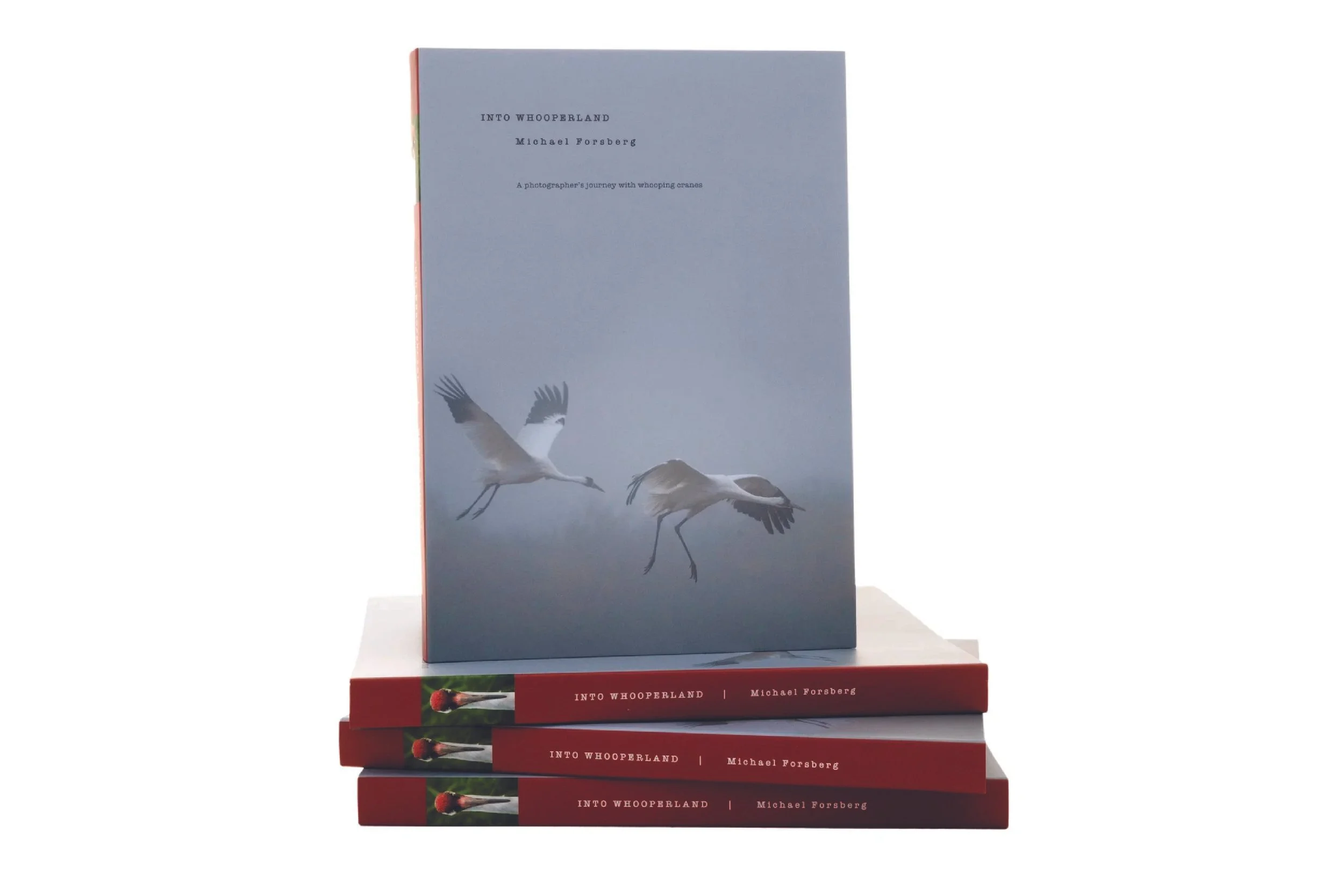
The big white bird is our harbinger of hope, a symbol of wildlife’s future in America.
Over the past 70 years, we have vested our wildlife conscience into the well-being of the whooping crane (Grus americana). The whooper speaks to us as no other creature does. Elegant, spiritual, fleeting—the tallest American bird is among its most imperiled.
From the storied recovery of a few dozen whoopers in the 1940s to the daunting obstacles the species faces today, the whooper has won an extraordinary human effort to ensure its survival. It is today’s measure of mankind’s effort, ingenuity and commitment to creatures other than our own. Over time other species—the bison, the California condor, the dodo, passenger pigeon and bald eagle—have tested and spoken truths about the human animal. But today, no other creature better reflects Americans’ attitudes, attention and concerns toward nature than the beautiful whooping crane.
Over five years photographer and author Mike Forsberg immersed himself in whooperland—a universe of another kind and yet reliant on human care. He followed the last wild population, numbering some 540 birds, on their narrow, 2,500-mile Great Plains flyway from the Texas Gulf Coast to nesting grounds in remote boreal forests of Canada’s Northwest Territories.
From inside the whooper portal, Mike shares the birds’ saga in this remarkable book. He tells the extraordinary stories of tough, adaptive individual birds and families. He follows them by truck and small plane through wetlands, marshes and rivers. He finds them on the nest, hatching and protecting the young; dancing at sunrise in the marsh; braving nature’s blizzards and human callousness. And he explores the loose network of committed biologists, wildlife teams and volunteers who share their successes and failures in maintaining and restoring the species.
At every turn, Mike finds the birds’ essence in notes written in cramped blinds and with stunningly beautiful images, capturing cranes in their chosen places up and down the continent.
Welcome to whooperland, a special world.
Foreword by Dr. Rich Beilfuss, CEO of International Crane Foundation with contributing essay by Rene Ebersole.
224 pages, color and black & white photographs, soft cover, 7 x 10 inches, printed in the USA.
TO SEE MORE – www.michaelforsberg.com/intowhooperland
Journals

Limited quantity, so get them while they last!
A simple stocking stuffer. These beautiful journals have 200 lined pages, with image wrapped around the spine and geographic and biographic information for the species on the back. Choose between “joy sandhill crane” or “bison in wonderland”.
Bestselling Fine Art Prints
Bring the beauty of the Great Plains into your home or the home of someone you love. These are some of Michael’s most iconic fine art prints from more than 30 years of conservation work in the Great Plains.


NEW Fine Art Prints
These are some of Michael’s newest fine art prints. Be the first to have these lovely wildlife portraits in your home!
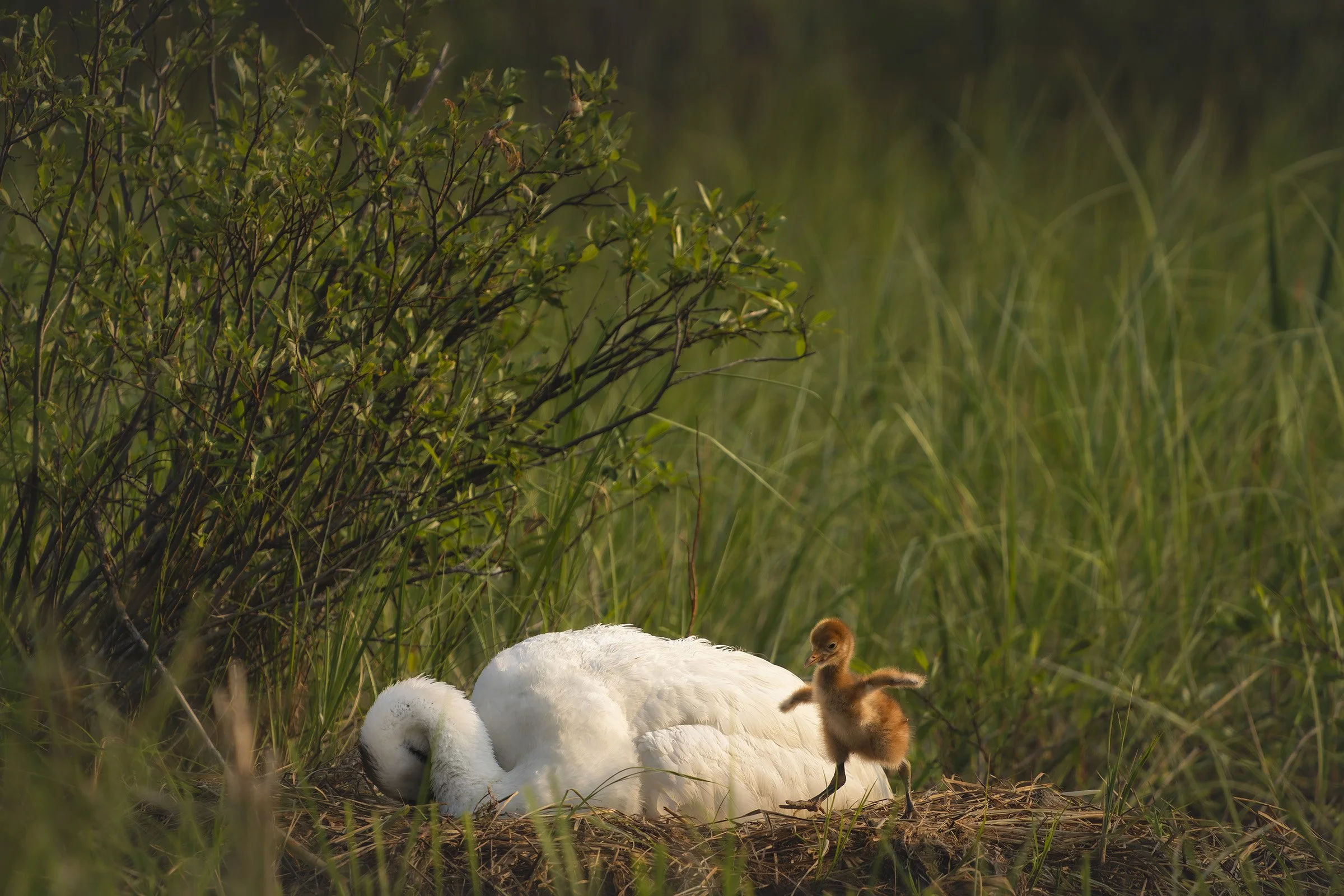
A whooping crane parent tries to catch a nap while her two-day-old chick races around the nest.
Born feathered with eyes open, whooping crane chicks (called “colts”) are precocial, meaning they can stand up within hours of being hatched and almost immediately mobile around the nest. The colts continue to glean nutrition from the egg’s yolk sac for the first 24 hours or so, but then must begin to receive food, mostly aquatic insects and other invertebrates, plucked from the wetland grocery store and by mom and dad.
After a few days, crane parents lead their colts away from the nest into the farther reaches of their nesting territory to seek new food sources and safe places to rest.
Crane colts can grow roughly an inch a day. It is one of the fastest growth rates of all birds. Imagine a whooping crane chick born the size of a softball in early June, and by October be nearly the size of its parents, capable of flight, and ready to follow them on a long distance 2500-mile migration down the heart of the continent.
Wood Buffalo National Park, Canada.
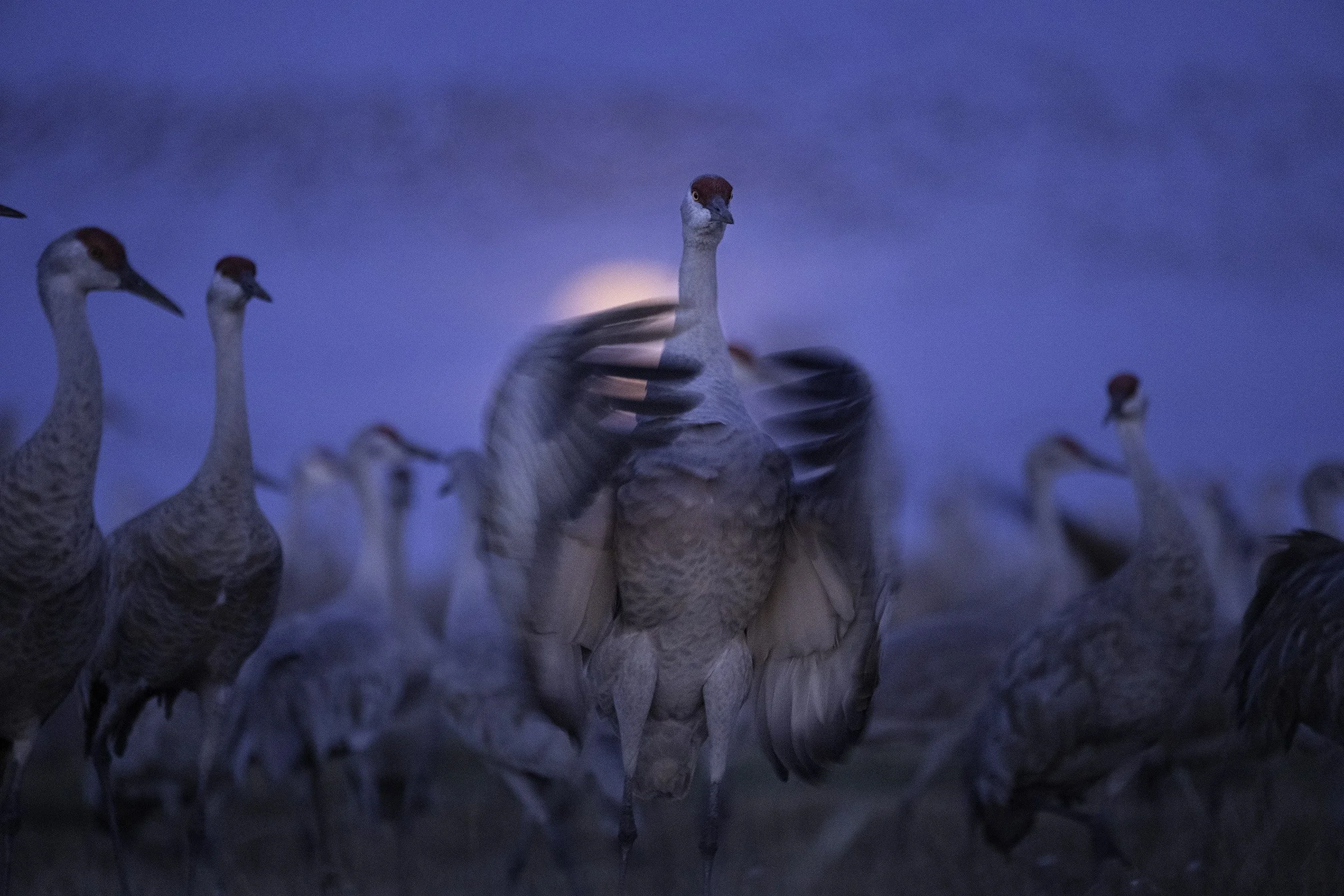
At moonrise, their voices rose in crescendo, and for a moment her wings held the whole world together. Then she and ten thousand wings on migration to the rim of the world, lifted off from the meadow like a gray wave pounding the surf, breaking into the river roost until it was too dark to see.
Audubon Rowe Sanctuary
Platte River
Nebraska
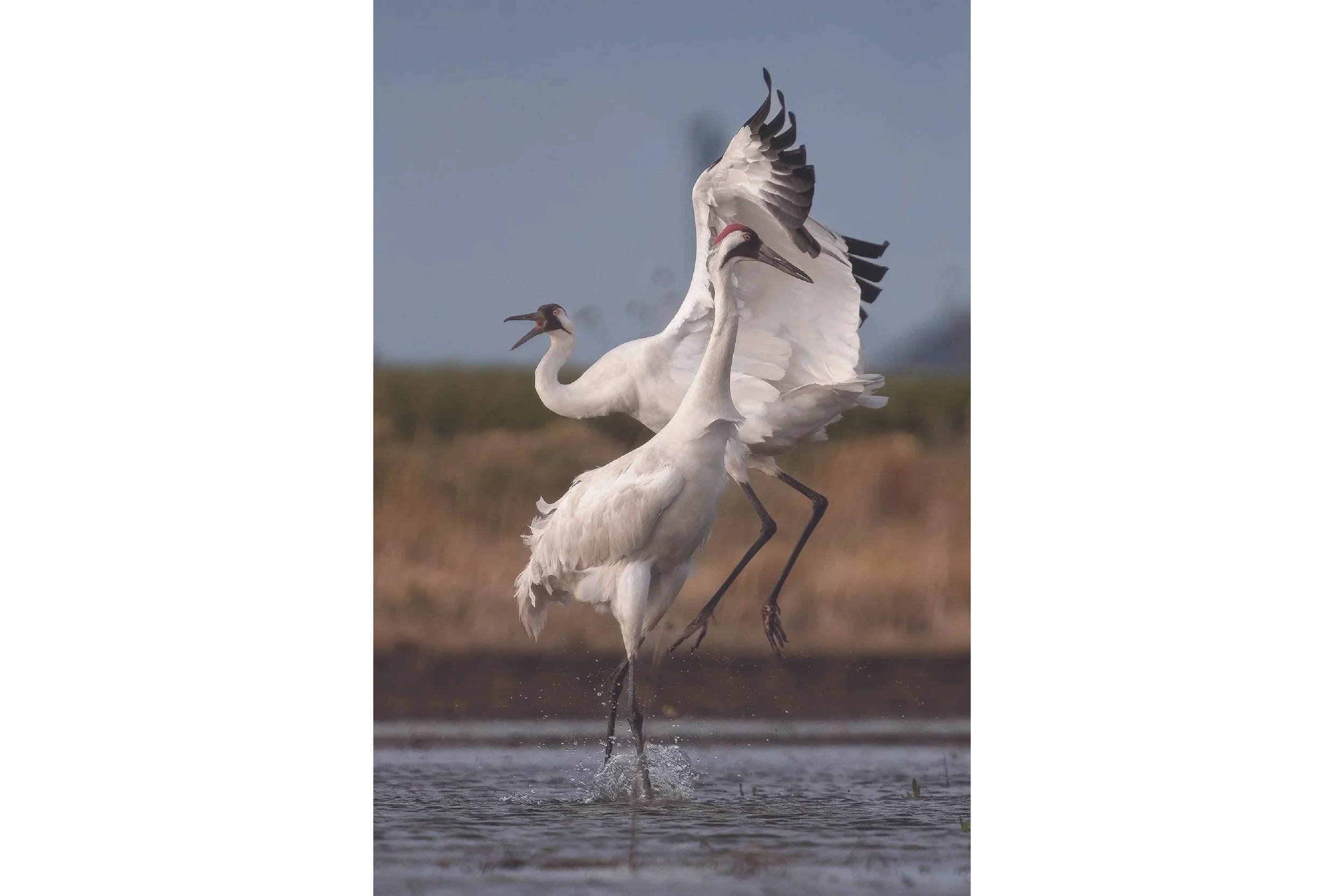
With tall, slender bodies, long legs, and huge wings, a whooping cranes’ movements are awkwardly graceful.
These birds are hardwired to dance-at any time of day, in all seasons, and with everyone in their group. Parents dance with their chicks to strengthen family bonds. Rivals leap and prance to settle disputes. Subadults pirouette to impress suitors.
The cranes’ elaborate moves – circling, leaping, stick tossing, spreading wings, heads down, crowns raised – have names like tour-jete’, minuet, salute, and curtsy. Dancing season peaks in the spring, fueled by hormones that propel the birds to copulate and establish nests on breeding grounds. Some mates dance together for decades. And maybe sometimes, cranes dance for the same reasons we do – to relieve stress and to have fun!
Funk Waterfowl Production Area, Nebraska.
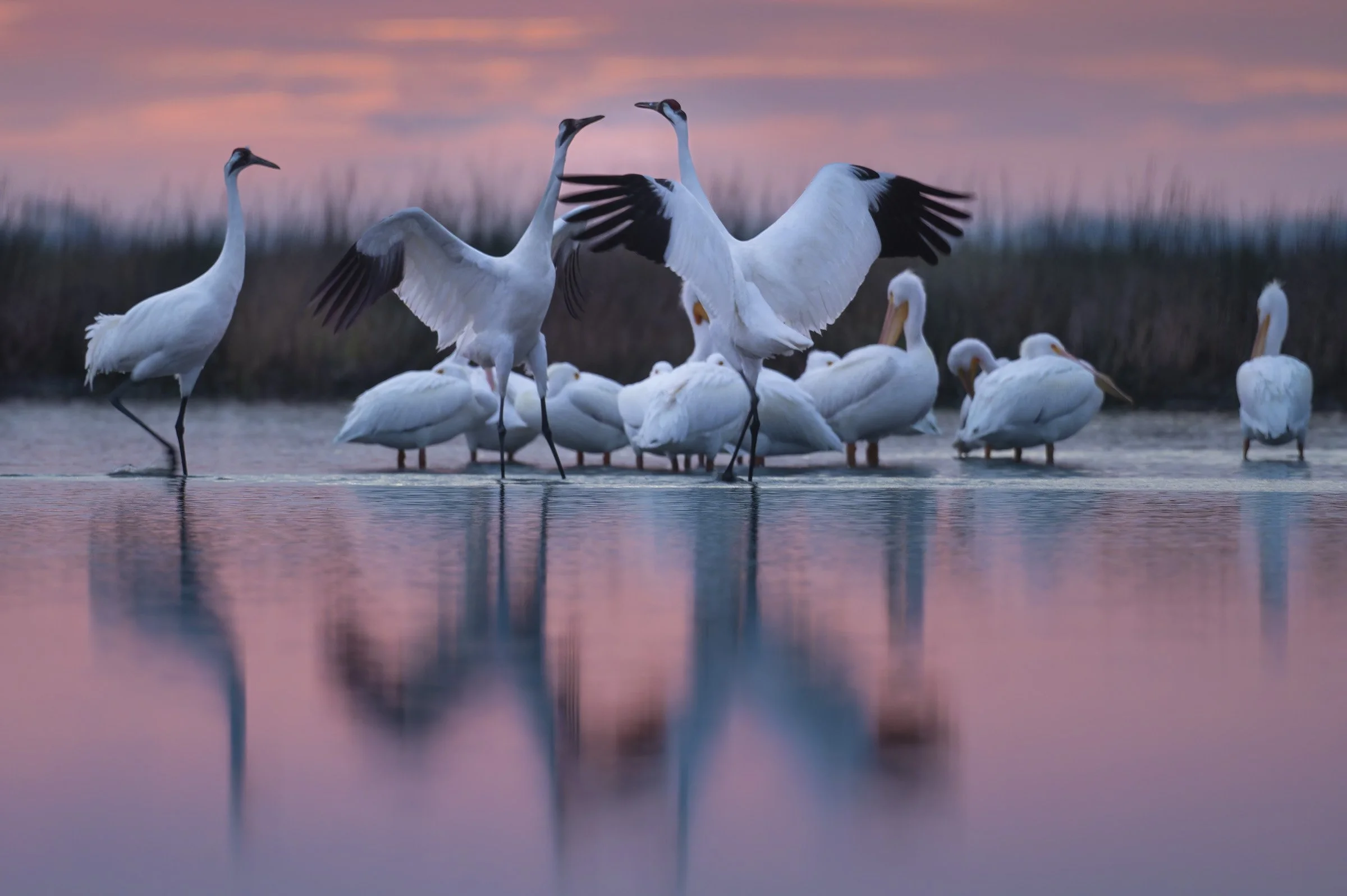
At the first blush of a new day on the Texas Gulf Coast, wintering whooping cranes and white pelicans wake up together on a secluded salt marsh deep in the refuge.
Before they leave the roost, the whoopers will first interact, stretch and preen. Then as the sun rises over the horizon, they’ll take off to nearby wetlands, pastures or wade out from the marsh to the shoreline to feed.
Whooping cranes and white pelicans are frequently seen in the same habitats together during migration and on wintering grounds. Both ancient species whose lineages go back deep in Earth’s history, surely they have been sharing roosts like this one for millennia.
Aransas National Wildlife Refuge, Texas.
gift Card

Give the gift of choice. Let your loved ones find something they will cherish with a Michael Forsberg gift card–redeemable for fine art prints, books, and anything else available on our website.
